Start a Furnace in Your Area — Let's talk

A Vision Document
A Vision for
Gathered
Worship.
What the space we inhabit says about what we believe — before a single word is spoken.
the Furnace Christian Fellowship · Canton, Ohio
Preface
What follows is not a building proposal or a program redesign. It is a vision — received in prayer, tested against Scripture, and offered to the body for discernment. It describes what gathered worship at The Furnace may one day look like when the space we inhabit is allowed to say what we already believe.
Every element described below is a theological decision before it is a practical one. The room itself will be a confession of faith.
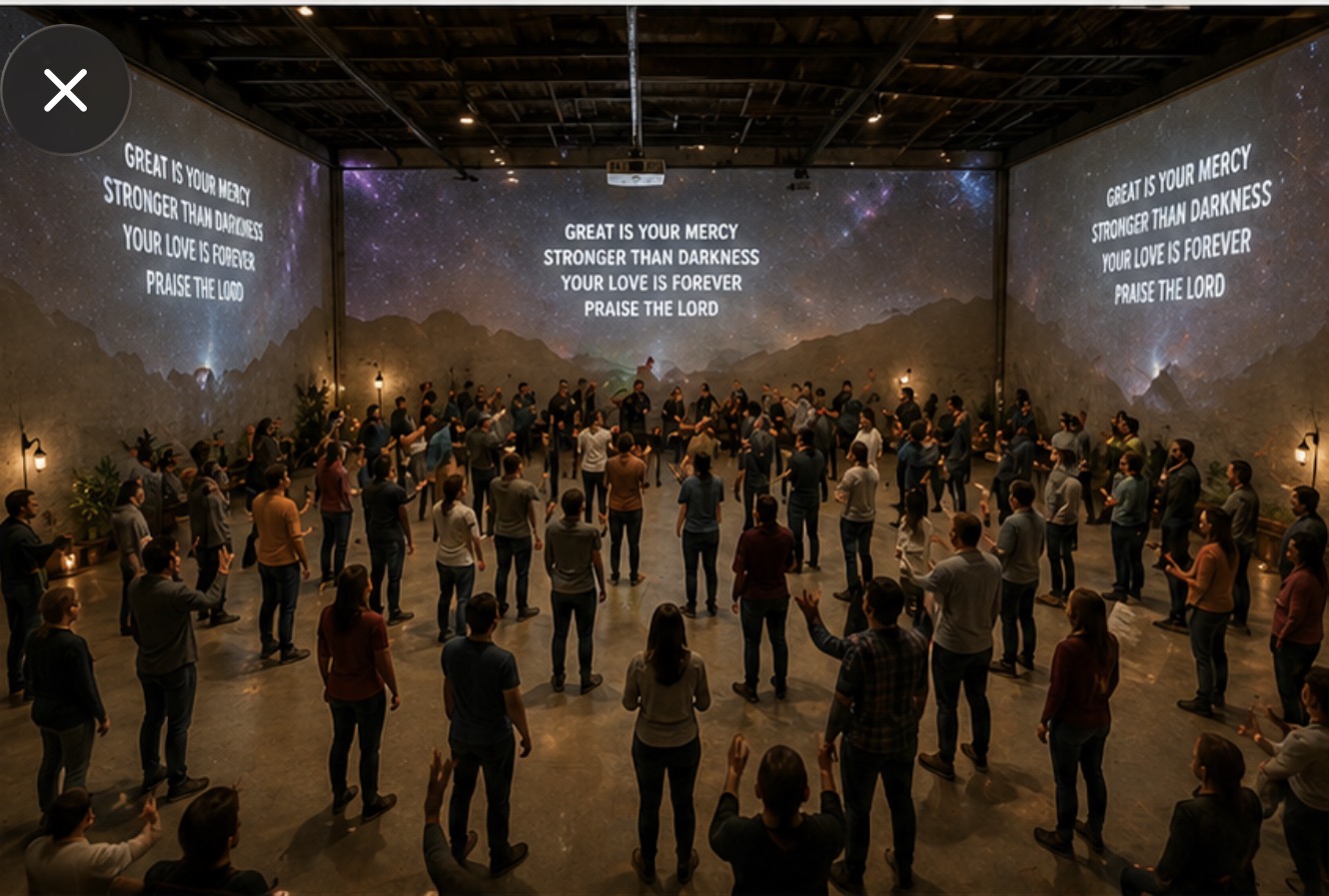
AI-generated concept image · A vision, not a photograph
The Space
No Front. No Back.
We gather in a warehouse or open industrial space — unadorned, stripped of the ornamentation that signals religious performance. The floor is concrete. The ceiling is open. The walls are bare except for what is projected upon them.
Four walls. Four screens. The congregation stands inside a continuous immersive environment of image and lyric that wraps the entire room. There is no front wall. There is no back wall. There is no stage. There is no direction the room points except inward, toward one another, and upward, toward God.
Wherever you stand in this room, you are equally inside the worship. You are not facing it. You are not observing it from a distance. You are standing within it.
This is not aesthetic preference. It is ecclesiology made physical. The room says, before a single word is spoken: there is no performer here. You have not come to watch. You have come to enter in.
The Communion Table
At the Center.
At the center of the room stands the Table. Not against a wall. Not elevated on a platform. At the center — the gravitational heart of the space, visible from every point in the room.
Whatever occupies the center of a room is what the room confesses matters most. In a traditional church that is the pulpit or the stage, directing attention toward a gifted human being. Here it is the Table of the Lord.
The Eucharist is not a concluding ritual appended to the real event. It is the reason the room exists. The architecture confesses this before the gathering begins.
Music
From Within.
If there is a band, it is scattered throughout the space, or positioned behind one of the projection walls, or gathered at the center near the Table. There is no music stage. There is no concert lighting separating musicians from congregation.
Music in this room does not come from a platform toward the people. It arises from within the room itself — environmental, atmospheric, surrounding. The congregation does not watch musicians. They breathe music that seems to emerge from the gathered body.
This changes the phenomenology of worship entirely. Sound becomes indistinguishable from environment. The congregation is not an audience. It is a source.
The Teaching
Among the People.
The teacher does not stand behind a pulpit or on a platform. The teacher moves.
Following the model of Jesus among his disciples and the Socratic tradition of wisdom sought through dialogue and presence, the teacher wanders through the congregation as he teaches — pausing near one person, addressing another, drawing the room into the inquiry rather than delivering conclusions to it from above.
This signals something essential: wisdom belongs to the gathering. The Spirit has already been distributed through the body. Teaching does not descend upon the congregation from a height. It emerges from among them, finding what the Spirit has already placed in the room.
The teacher is never above the people physically. He is among them. This is not informality. It is a deliberate recovery of how the Rabbi taught.
The Administration of Communion
Grace Moves Outward.
When the moment of the Table arrives, the pastor and elders do not summon the congregation to form a line. They take the elements and move outward from the center.
The elders walk through the congregation, bringing the bread and the cup to the people where they stand. Grace moves from the center toward the periphery. The shepherd goes to the sheep. The feast comes to the guest.
Following the elders, prayer ministers move through the same space — laying hands gently on those who have received, praying quietly, attending to whatever the Spirit surfaces in the moment of reception.
The bread and wine flow through the room. Hands of prayer follow in their wake. The two ancient acts — Eucharist and anointing — are held together in a single movement through the body. This is James 5 and 1 Corinthians 11 occupying the same moment. Healing and remembrance. Presence and participation.
No one manages a line. No one administers from behind a table. The elders move as servants, kneeling if necessary, offering what they carry to each person in turn.
The Children
Always Present.
Children remain in the room. Always.
There is no children’s church at The Furnace. There is no parallel program, no age-segregated environment designed to manage young bodies away from the gathered body. Children participate in the worship, in the teaching, in the communion moment, at whatever level their age and formation allow.
This is not a logistical experiment. It is a recovery of the oldest Christian practice. The segregation of children from the worshipping body has no precedent in Scripture and no root in the early church. It is a modern innovation, born of institutional convenience, and it produces a generation that grows up alongside the Church rather than inside it.
A child who watches an elder kneel to offer bread to their parent — who watches hands laid gently on a bowed head, who watches someone weep or lift their hands in the presence of God — is receiving formation that no curriculum can replicate. They are learning what the Church is by inhabiting it.
Scripture itself assumes the presence of children in the gathered community. When Peter stood on the day of Pentecost and declared, “Your sons and daughters will prophesy” (Acts 2:17, quoting Joel 2:28), he was not describing a future children’s program. He was describing the gathered body — young and old together, all of them recipients of the outpoured Spirit, all of them participants in the prophetic community. You cannot prophesy in a meeting you have been removed from.
What This Vision Is
Not Innovation. Recovery.
Taken whole, this is not a reimagining of church for contemporary tastes. It is a recovery.
The architecture that encodes no hierarchy. The Table at the center. The music that arises from within. The teacher who moves among the people. The elders who bring the feast to the congregation rather than summoning the congregation to the feast. The children who are present for all of it.
Every one of these is older than the model it replaces. Every one has deep roots in Scripture, in the patristic witness, and in the practice of the church before the age of platforms and programs.
We are not innovating. We are remembering.
We are not innovating.
We are remembering.